Second installment in an original alternative history series
Fiction by Thomas Shess

***
Friday, August 9, 2019, 11 a.m.
A white U.S. Customs paddy wagon pulled out of Teterboro Airport. The sky was partly cloudy, the temperature climbing toward the low eighties. As the Ford Transit cleared the airport perimeter, Manhattan appeared beyond the warehouses—a pale, jagged skyline twelve miles to the east, sharp in the hard late-morning light.
Chained in the back row of fake-leather seats, Jules Jewelson pursed his lips. His stomach hit bottom when he asked where the feds were taking him.
“Metropolitan Correctional Center. Manhattan’s only free hotel,” said the uniformed driver.
No one laughed.
Given what the government had on him, the odds were eighty-twenty that Jules would never again see the world through windows without bars.
The wild-eyed hedge-fund genius turned pimp knew he was toast. Forty-eight hours earlier, drunk at his own party, he had kicked one of his cadre of popular young hookers in the ass.
Trinket, a two-year veteran of the main line, took offense. The party, after all, was celebrating her eighteenth birthday, and half the high rollers Jules had introduced her to were watching.
“Man, you don’t do something like that with all her friends there,” Dimitri Yugoslav told him over the telephone after Jules landed in custody. “Besides, why are you calling me? I don’t work for your side, and I told you never to call me here at the embassy again.”
“You know why I’m calling.”
“Because she’s Pennsylvania Avenue’s sweetheart, but you’re the teddy bear who introduced her around. Not me.”
Jules panicked. “Tell her to back off. Tell the feds I never touched her.”
“Everyone saw you kick her.”
“Were you there?”
“You forget P—- had it on Zoom. He told me.”
“Fuck me,” Jules said.
“Now everyone thinks you’ll make a deal to get out.”
“You included?”
“I still have the shower tapes.”
“So get me out or I’ll spill.”
“No. They’re in a Kremlin vault. I’m not your guy.”
“Find me a lawyer.”
“I can’t hear you. Something’s wrong with the line.”
“Don’t hang up, Dim. You’re my last call.”
Click.
***
That evening at 8:37, MCC guards came for Jewelson’s temporary cellmate.
There had been no warning. One moment Victor Kutov was on the upper bunk, using a thumbnail to score the days into the cardboard back of a legal pad. The next, keys rattled outside and an officer ordered him to roll his bedding.
“Where am I going?” Kutov asked.
“You’re free. Charges dropped on one condition.”
“What condition?”
“There’s a plane in Jersey waiting to take you back to Ukraine.”
“I can beat the beef.”
“Pack.”
“That wasn’t my question.”
The officer stared through the narrow window. “It was the answer.”
Kutov climbed down. He had the thick neck and watchful stillness of a man who survived by noticing what other men ignored. Before prison he had worn a badge in Odesa. After prison he had become a bargaining chip. That meant he understood procedure well enough to recognize when procedure had disappeared.
Jules stood beside the lower bunk in orange prison garb, one hand on the mattress. He looked smaller than he had in the newspapers. Jail had removed the tailoring, the aircraft, the island near Haiti and the people who laughed before he finished speaking. What remained was a forty-eight-year-old man with soft hands and a face beginning to collapse inward.
Kutov rolled his blanket tightly.
“Find friends fast, Jules. Everybody knows you have the dough.”
“Hey. You’re not leaving me alone,” Jules shouted toward the door. “I want another bunkie. ASAP.”
Kutov looked at him for what both men suspected would be the last time. All afternoon they had spoken in fragments, never trusting the walls. Jules talked in circles and confessed nothing. The Ukrainian had asked for nothing. They discussed only survival: which guard slept, which one gambled, which doors stuck, which lights flickered before the breaker tripped. Men in confinement became students of small failures.
Kutov lifted his bedding.
“Stick to the plan,” he said.
Jules stared at his feet. If he looked up he would see the firing squad.
Kutov stepped into the corridor. The steel door shut between them.
Looking back, through its small window, Kutov saw a grown man cry.
Jules stood still for several seconds, then turned toward the urinal. He washed his hands and dried them by running his fingers through his dyed blond hair.
The tier settled into its night noises: plumbing, muttered curses, a cough traveling from cell to cell. Somewhere a television carried the faint fake applause of a game show. The sound made the place seem less like a tomb and therefore more dangerous.
He worked quickly.
The defense Kutov had devised was crude and desperate, assembled from things that should never have been in the same cell. Kutov had insisted it was not designed to kill. A dead intruder could be blamed on the prisoner. A living one might have a name.
Jules loosened the mattress from the lower bunk and positioned it so he could pull it upright with one motion. He dampened a sheet in the sink and folded it near the foot of the bed. Hidden inside the torn mattress seam was the shank Kutov had left behind.
Then Jules sat down.
At 10:30 a guard passed the door and looked in without stopping.
At 11:16 the television went silent.
At 11:41 Jules heard laughter from the officers’ station.
At 11:58 the lights dimmed, brightened and dimmed again.
At 12:07 the lock on his cell clicked.
No announcement followed. No officer called his name.
The door opened four inches.
Jules remained on the bunk, breathing through his mouth.
The first man entered sideways. He wore prison orange, but his shoes were black work shoes without laces. The second man was broader and carried something close to his thigh. Neither looked toward the camera at the end of the tier.
They had been told it was dead.
The first man eased the door shut.
“Get off the bed,” he whispered to the prisoner.
Jules did not move.
The broad man stepped forward. Moonlight from the narrow window touched the object in his hand. It was short, heavy and wrapped in cloth.
“Off.”
Jules pulled the mattress upright.
The first blow struck Jules with a flat, ugly sound. The force drove Jules backward, but the mattress absorbed enough to keep him standing. He shoved forward. The first man stumbled into the second.
Jules followed the plan until fear tore the plan apart.
He slashed the broad man’s hand, then drove the shank into the other man’s eye. The scream that followed seemed too large for a human throat. The broad man swung blindly. Jules caught the blow on his shoulder, went down, came up beneath him and stabbed until the heavy object hit the floor.
The first man was still alive. He crawled toward the door, one hand pressed to his ruined face.
Jules could have let him go.
Instead he remembered Trinket, the island, the tapes, the politicians who had shaken his hand and the men who would never permit him to testify. He jumped on the crawling man’s back and pulled the wet sheet tight across his throat.
By the time the alarm brought half the tier running, both intruders were dead.
Jules dropped the sheet. He stepped away from the bodies, climbed onto the upper bunk and placed his hands behind his head.
The door flew open.
Six officers aimed pepper guns and batons at him.
“Down! Face down!”
Jules looked at the blood spreading beneath the lower bunk.
“Not in that,” he said.
They dragged him through it anyway.
***
By two in the morning, Jules was alone in an observation cell wearing a paper smock. A camera watched him from the ceiling. Light burned without mercy. Every fifteen minutes an officer stopped at the glass and wrote something on a clipboard.
The dead men had no prison identification. Their orange uniforms had been stolen from laundry. One carried a braided cord; the other carried a sand-filled length of fire hose. Their fingerprints belonged to men who, according to federal databases, were not in New York.
One had entered the United States through a diplomatic channel three days earlier.
The other had been officially dead since 2014.
At dawn the warden arrived with two FBI agents and an assistant United States attorney named Miriam Raines. Raines was forty, exhausted and too intelligent to pretend the night made sense.
“You killed two men,” Raines said through the slot.
“They came to kill me.”
“You strangled one of them after disabling him.”
“He was leaving to bring friends.”
“You hid the weapon.”
“I preserved it.”
“In another man’s rectum?”
Jules smiled for the first time since Teterboro. “Safe from contamination.”
Raines did not smile back.
“Who warned you?”
“No one.”
“Your cellmate was released hours before the attack.”
“Lucky Victor.”
“He has disappeared.”
“Luckier Victor.”
Raines leaned closer to the opening. “Two men entered a locked federal cell on a secured tier during a camera failure. Someone gave them uniforms. Someone opened the door. Someone expected you to die. That makes you either the most important witness in America or the most dangerous liar in federal custody.”
“Can’t I be both?”
The warden ordered the slot closed.
Raines stopped him.
“What do you want, Mr. Jewelson?”
“A lawyer. And I don’t want to die.”
“You’ll get a room where we can watch you.”
“Why?”
“Suicide prevention protocol.”
“And milk with every meal.”
Raines studied him.
“Milk?”
“Yes. A small carton every meal. Bananas, too, if the government can afford them. Calcium and potassium deficiencies run in my family.”
***
The government buried the killings under the phrase attempted inmate assault. No names were released. The dead men became John Doe One and John Doe Two, and the tier remained locked down while correctional officers searched cells, lockers, laundry carts and one another.
Jules was transferred to a secure medical unit at another federal facility under a false name. Only six officials knew where he was. Three of them wanted him prosecuted for murder. Two wanted him alive long enough to testify to Congress. The sixth reported to someone whose had top Secret Service security clearance.
Raines returned with Leonard Bell, a defense lawyer whose suits cost more than most people’s cars. Bell had represented oil ministers; casino families and one televangelist whose private jet contained a bedroom without windows.
Bell sat behind the glass and picked up the telephone.
“Your retainer cleared,” he said.
“Of course it did.”
“You are facing two murder counts in addition to the trafficking case.”
“They were assassins.”
“One was crawling away.”
“Toward the door.”
“The government will call it execution.”
“The government let them in.”
Bell looked at Raines, who stood against the wall.
“That,” he said, “is the only reason you are still breathing.”
Jules put his palm against the glass.
“I have another insurance policy.”
“I know about the tapes.”
“You know about some tapes.”
“What else?”
“Names.”
“How many?”
“Enough to change governments.”
Raines stepped forward. “Give them to us.”
“And wake up dead?”
“You are already in federal protection.”
Jules laughed. “Miriam, two corpses entered my locked cell in matching pajamas.”
Bell lowered his voice. “What do you want?”
“Until just now I would have taken seven years on the original charges. No murder indictment. A federal camp. Credit for time served. Now I want total freedom. Protective identity starting immediately. Fake my death and set me free where the sun shines all the time and no one speaks English.”
Raines said, “Impossible.”
Jules turned to her.
“Then every two weeks somebody’s name becomes famous because they play kissy face with naked 13-year-olds with braces.”
“No. I call the shots.” Raines said, “You’ll stay shut down until you give me bonafide high ranking Johns. Cooperate. You got no choice. You don’t exist. No one knows where you are. Nothing leaves to the outside. You have no way to communicate.”
Jules looked down at the milk carton on his side of the glass.
Raines followed his eyes.
It meant nothing to her.
Not yet.
***
The first name appeared in The Guardian eleven days later.
The London newspaper received a telephone call from a man using a disposable phone. He gave the name of a royal’s brother, the date of three visits to Jewelson’s beachfront property near Haiti and the first four digits of a private aircraft’s tail number. The paper confirmed the flights and published.
Britain detonated before breakfast scones left the ovens.
The palace denied everything. The royal resigned from six charities by lunch. Television crews surrounded his country house. Parliament demanded records. Jules watched the coverage on a wall-mounted television with no sound and drank his milk.
Two weeks later an heir to a Dallas oilman was named.They had kept the family name and corporate logo out of the press since the Warren Commission was published. Now old ghost were screaming. Lawyers were checking trust fund fine print to see if moral turpitude mattered.
An anonymous caller with a New Jersey accept supplied the Waco Sentinel with an exclusive supplying the suite number of a Caribbean hotel, the nickname of a girl then fifteen, and a wire transfer routed through an art foundation. Federal agents sealed the foundation’s offices before noon. The heir, Jr. boarded a plane for Argentina and discovered, while taxiing, that his passport had been canceled.
The third name belonged to Washington.
Not the White House, but close enough to turn every corridor in the capital cold.
News organizations began calendars counting down to the next big name release. Cable anchors called it Jewelson Friday Freebie. Markets dipped on rumors. Ambassadors canceled travel. Men who had spent their lives demanding law and order hired criminal lawyers and bought burner telephones.
Eventually, Raines returned to Jules’s unit with three FBI agents and a warrant to tear apart everything he touched.
They searched his legal mail, his food trays, his toilet, his mattress and even the seams of his paper slippers. They found nothing.
But the black book names kept showing up in the media. Defense lawyers were jamming White House private lines. Access to the Oval Office was selling at near record levels. Press office installed a take-a-number to fend off the frenzy.
Raines found nothing in Jules’s cell. “How’s he getting names out?”
“Someone on the outside,” one agent said blithely.
“But it’s Jules on the inside giving the orders. How?”
Someday history—not the media—would show how Jules did it.
The method was embarrassingly small.
At each meal Jules received a half-pint milk carton printed with a block of nutrition text. Using the tine of a plastic fork, he punched one tiny hole beneath one letter. Sometimes the letter came from “pasteurized.” Sometimes from “vitamin.” Sometimes from the dairy’s address. He returned the carton with the tray.
In the dish room, a trustee named Ellis Mott separated Jules’s cartons from the trash. Mott had been paid through his sister’s mortgage, his mother’s dental work and a college account opened for a daughter he had not seen in four years.
One carton provided one letter.
When Mott had assembled a full name, he memorized it, destroyed the cartons and waited until his next outside medical detail. A dishwasher in a prison kitchen was invisible. A prisoner taking out garbage was less than invisible. At a gas-station restroom, Mott called Jules pre-arranged media contacts from a different burner phone.
Reporter verified enough spoon fed detail to make the allegation publishable. Someone then paid the Sentinel’s printing bill that was six months in arrears and all without revealing the source.
No paper changed hands. No recording existed. No single milk carton contained a whole message.
The government searched for a sophisticated communications network and missed the garbage.
***
After the fifth name revealed and caused the collapse of the 245-year-old Bank of the American Revolution, Miriam Raines came to see Jules alone.
She placed no files on the table. She did not bring Leonard Bell.
“Who is next?” she asked.
Jules Jewelson smiled. “You know I can’t spoil the program.”
“A White House name?”
“Could be.”
“Current?”
“Could be.”
“Your allegations could destroy innocent people.”
“They could.”
“You don’t care?”
“I care about living. I live they skate.”
Raines stared at him eyes to eyes. She had spent twenty years believing facts were hard objects. Jewelson had turned them into the rockets red glare. Some of his names would be guilty. Some might only have attended a dinner, boarded an airplane or shaken his hand. By the time ten more names were dumped, families and governments would already be burning. Not since 1814 had Washington been this hot.
“You’re a blackmailer,” she said.
“No. We’re negotiating. You have me in jail; I have names that will destroy the government as we know it. You want the names. I want unrestricted freedom and compensation for a lifetime.”
Raines said, “Anything that touches the West Wing will kill you—plain and simple.”
“That was a threat. See what I mean? Scared, no?”
Raines remained seated.
Jules leaned toward the glass.
“If you kill me, the entire black book goes public. Every celebrity client. Every politician. Every girl. Names, dates, photographs, flight records. Everything.”
“Not if we find the book first.”
“You won’t.”
“We’re going to try.”
“You have exactly as much time as it takes your people to kill me.”
Raines looked almost tired enough to smile.
“That is where you’re wrong.”
Jules waited.
She said, “We have as much time as it takes our people to create another black book.”
His smile faded.
“A copy?”
“A new one.”
“You don’t know enough.”
“We know you. We know Haiti, the aircraft, the hotels, the foundations and the people who wanted to be seen with you. Your real records give us the framework. We supply the missing pieces.”
“Fake names.”
“Some.”
“Fake victims.”
“Some.”
“Fake evidence.”
“Clean evidence. Hotel bills, wire transfers, photographs, aircraft manifests. Nothing too perfect. Perfect evidence makes people suspicious.”
Jules sat back.
“No one would believe it.”
“They will as soon as we finish the job. Fake news has nothing on fake evidence. No one will stop long enough to decide whether it’s real. Reporters will climb over one another to blow the roof off a big-name Democrat who’ll take the heat off the White House. Every television network will have its own black book. Every woman who ever met you will be offered money to tell her story. Women who never met you will tell better ones.”
“The girls will talk. They’ll say it’s not true.”
“We’re counting on it.”
“They know what happened,” Jules said.
“Each one knows what happened to her. Then come the lawyers, the reporters, the publishers, the documentaries and the women who remember being somewhere they never were. There will be so many versions that the public will gag on your name.”
“You don’t know what I know.”
“We make the truth impossible to identify. Politicians of every persuasion will have starring roles in golden showers. No one will figure out the fakes from the real tapes. We just need a bit more time,” Raines said.
“Then why are you here?”
“See you squirm.”
“I’ve got other tapes,” he insisted.
“So do we.”
“Not with the 12-year-old with your husband.”
Raines stood. “Last straw, scumbag.” She reached into her purse and removed a small pearl-handled .25-caliber Colt pistol.
Jules looked toward the dark one-way window behind her. He knew people were watching from the other side. He wanted them watching. Witnesses meant leverage. Witnesses meant the play was still alive.
“Of course, I have a right to see any new evidence and videos,” he snarled.
Raines did not answer.
“Your husband is a federal judge,” Jules said. “In good enough standing to be named to fill the next Supreme Court vacancy.”
Still nothing.
For the first time, Jules began to see that he had misread her silence. It was not fear. It was measurement.
“You should see your face,” he said.
Raines lifted the pistol.
“No more deals,” she said.
He smiled because smiling had saved him before. It had opened doors, softened rooms, made frightened people wait one second too long.
This time it did nothing.
The first shot struck him above the left eye.
Surprise held his face together for an instant, as if his body had not yet accepted what had happened. Then his knees loosened and he folded toward the cement floor.
Raines stepped closer.
She fired twice more.
Not because she had to.
Because she could.
The cell door opened before the echoes were gone. Two men entered wearing federal windbreakers and latex gloves. Neither looked at the body longer than necessary. One took the pistol from Raines. The other placed a folded paper garment over Jewelson’s face.
Raines removed her gloves carefully, finger by finger, and tossed them into the open plastic bag.
“I was never married,” she said.
No one answered.
By morning, the first story had already been written.
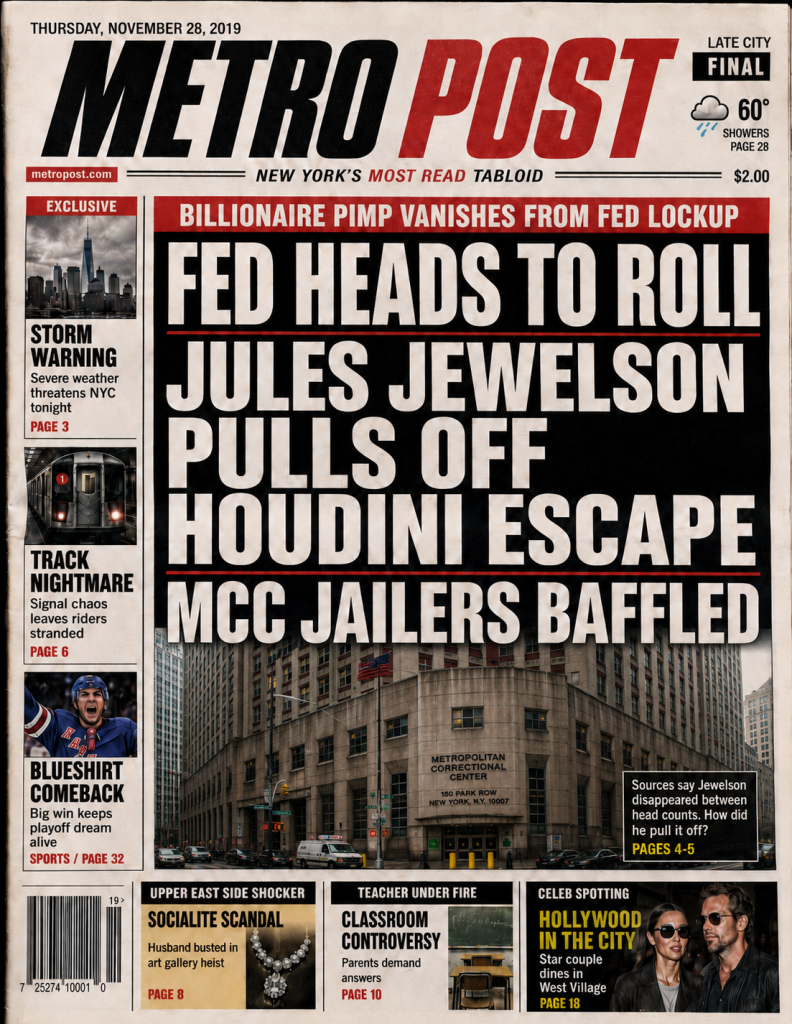
Tomorrow’s headlines began with Manhattan’s Metro Post: